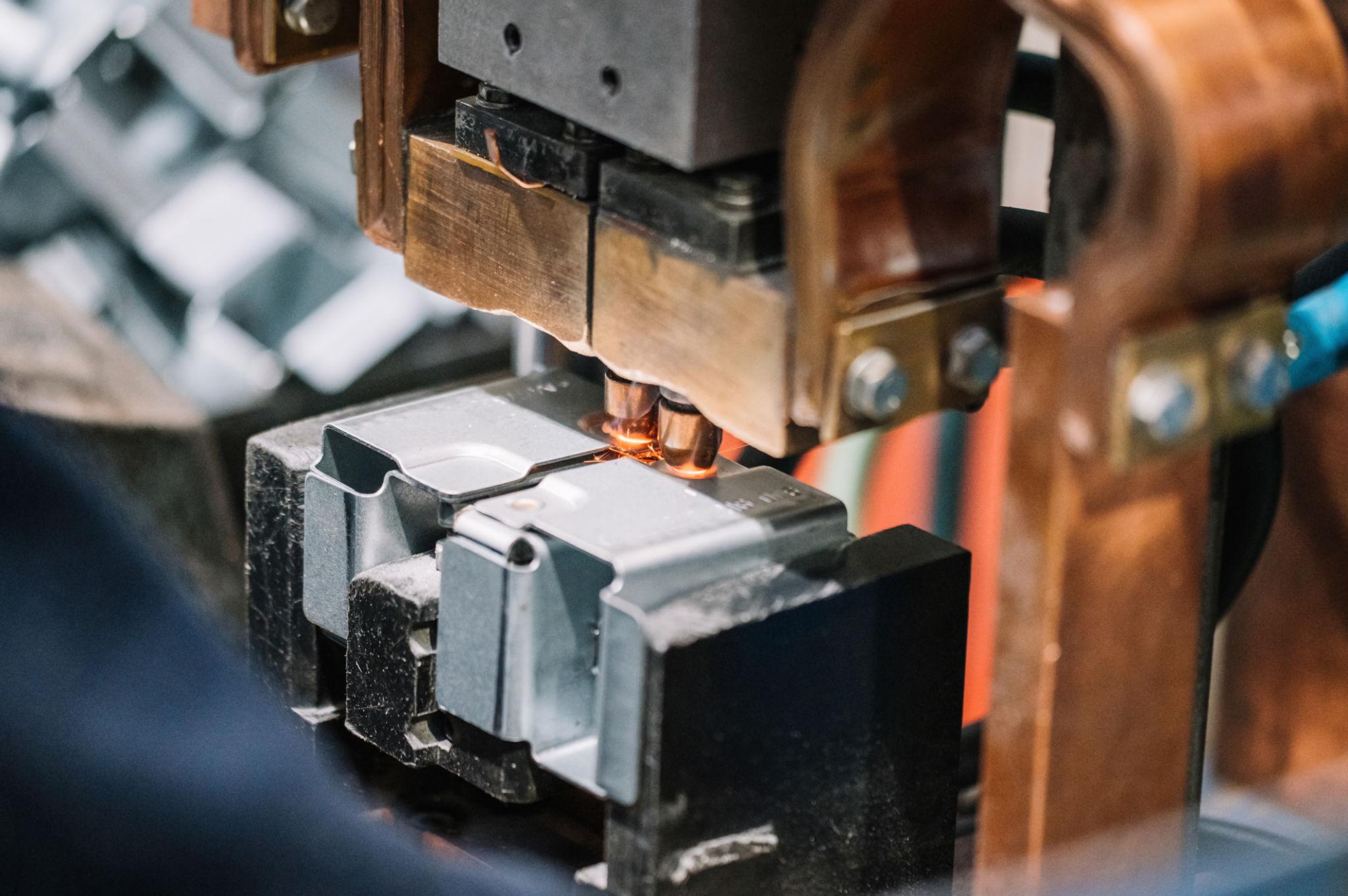
Spot Welding: Control, Quality, and Repeatability with MIBA

    16 July, 2026

Summary

Resistance spot welding is a fundamental technology for joining metal sheets, based on the Joule effect. It stands out for its efficiency and precision in series production. The complexity lies in process repeatability and the rigorous control of crucial parameters like current intensity, time, and pressure, all to prevent defects and thermal deformations. When executed correctly, it offers tangible advantages in joint quality, automation, and competitive costs.

Spot Welding: Principles and Industrial Applications

Joining two metal sheets is a fundamental step in countless industrial processes. Here, joint quality determines the structural strength and overall reliability of the assembly. Among available technologies,resistance spot welding stands out for its efficiency, precision, and clean aesthetic, establishing itself as a standard for series production. The underlying physical principle is the The underlying physical principle is theJoule effect: a high-intensity electric current, applied for a very short duration through two electrodes pressing the workpieces together, generates localized heat that melts the metal at the contact point. This seemingly simple process hides an operational complexity requiring rigorous parameter control and deep material knowledge.

Challenges and Process Control in Spot Welding

The true challenge in spot welding isn't making a single weld spot, but ensuring its repeatability across thousands of parts, avoiding the common issues that plague less equipped workshops. Process control relies on balancing three variables: current intensity, application time, and electrode pressure. Even slight inaccuracies in setting these parameters lead to critical defects. Insufficient current or duration creates a small, fragile weld nugget, compromising the joint's mechanical strength. Conversely, excess energy causes molten material expulsion, weakens the weld zone, and leaves an unacceptable aesthetic mark, generating production scrap hat directly impacts costs and delivery times. Another critical phenomenon is managing thermal deformations. Localized heat input can induce residual stresses, causing materials to warp, especially thin-gauge sheets. This problem is amplified in complex assemblies where dimensional accuracy is paramount. If welding jigs are not designed and built with the necessary rigidity and precision, or if they fail to account for the part's thermal expansion during the cycle, the final result will be an out-of-tolerance component.

Advantages and Quality Assurance

When executed correctly, the advantages of spot welding are tangible across the entire production chain, from designers to purchasing managers. For designers, this technology offers clean jointswithout filler material, requiring minimal to no surface treatments. It also lends itself to a high degree of automation, enabling high production rates. For purchasing managers, process efficiency translates into a highly competitive cost per weld spot for medium to large series production, with minimal material consumption. The return on investment becomes clear through reduced non-conformance rates and the long-term reliability of the component. Joint quality is validated through periodic destructive tests on production samples, such as peel tests, which measure the actual strength of the welded spot and ensure the process remains stable over time. This is precisely where MIBA's expertise, honed over five decades of field experience , lies: mastering a complex system to ensure final product quality.

WHAT IS YOUR
PROJECT?

MIBA turns your ideas into reality.

We carry out customised work according to your specifications and support you every step of the way.