MIBA Press-In Fasteners: Robust Threads for Thin Sheet Metal

    13 October, 2026

Summary

Press-in insert installation is a cold mechanical joining process that addresses the challenge of creating threads in thin sheet metal, ensuring robustness and repeatability. It demands rigorous control over the clinching process, from hole precision to press force, to fully leverage advantages like the absence of thermal input, high speed, and excellent joint strength. This approach ultimately reduces costs and improves production efficiency.

The Challenge of Threads in Thin Sheet Metal

Achieving strong threads in thin sheet metal consistently challenges every mechanical designer. Traditional techniques, such as welding nuts or direct tapping, exhibit clear limitations in terms of thermal deformation, mechanical integrity, and execution speed. Il Press-in insert installation stands out as a cold mechanical joining cold mechanical joining process that resolves these critical issues, providing a robust and repeatable fastening point essential for complex assemblies and series production. This technology, based on the controlled plastic deformation of the material, demands rigorous process control to prevent defects that can jeopardize entire orders.

How Press-In Insert Installation Works

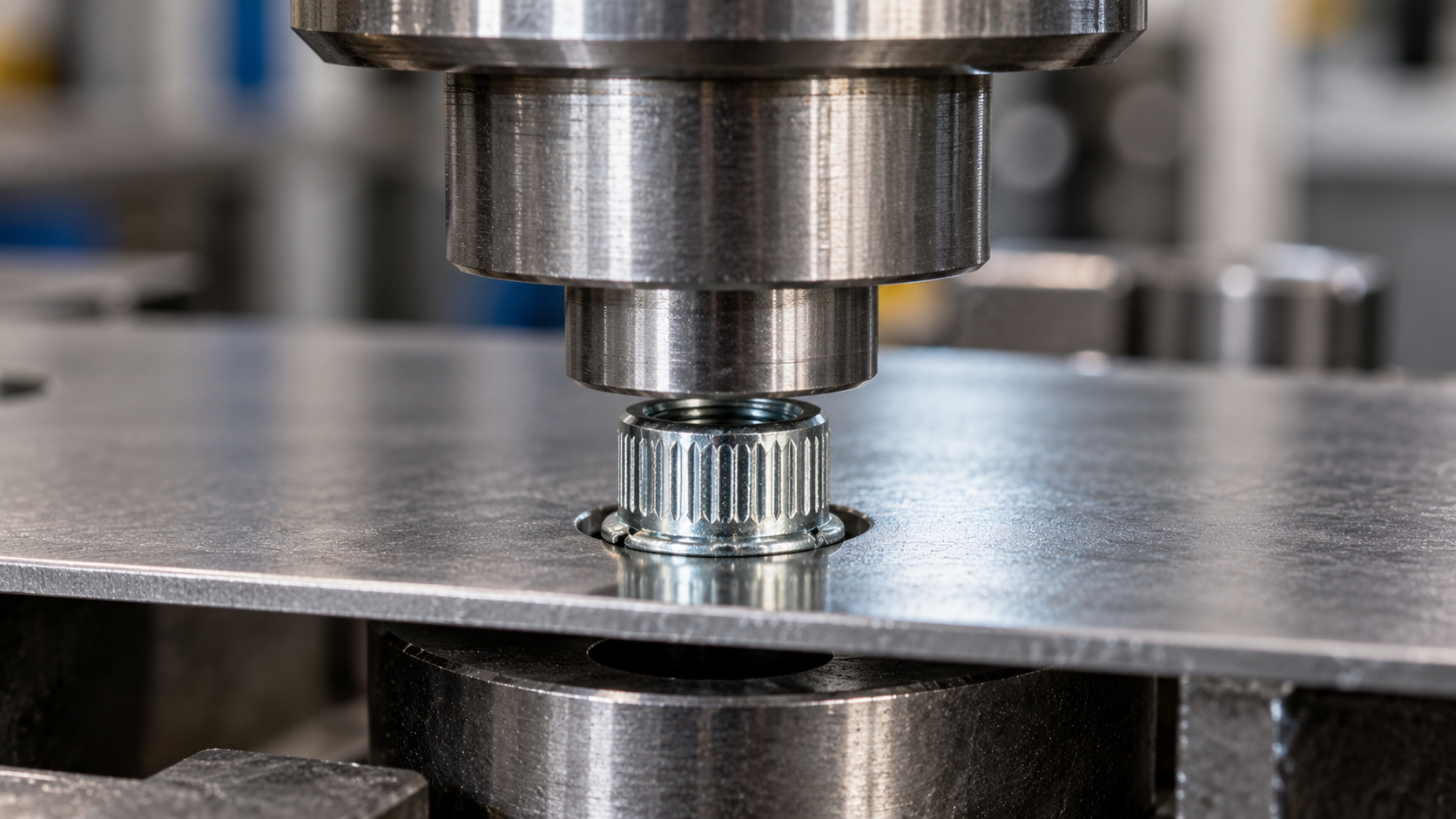
Installing a self-clinching fastener appears simple, but its effectiveness hinges on a series of interconnected technical parameters. The process involves applying a calibrated pressing force that drives the insert, designed with a specific geometry (a knurled head or an undercut), into a pre-drilled hole in the sheet metal. The applied pressure causes the sheet metal material, which is more ductile than the insert, to plastically deform and flow into the insert's serrations, creating a permanent mechanical anchor. The success of this operation relies on the precision of the housing hole. An oversized hole prevents the material from properly 'gripping,' leading to an insert that spins or pulls out under load. Conversely, an undersized hole can cause material fracture or visible deformation on the opposite surface, resulting in production scrap. Another critical factor is managing the press force. Insufficient pressure fails to complete the clinching process, while excessive force deforms the sheet metal. This is a particularly sensitive issue for large, thin panels, which tend to bow or warp. In the workshop, these problems translate into direct costs: welding jigs that no longer fit due to missed dimensional tolerances, or worse, entire production batches rejected during quality control.

Strategic Advantages and the MIBA Approach

Strategically opting for Press-in insert installation, over alternatives like welding, offers measurable benefits that extend beyond simple mechanical fastening, directly impacting total product cost and assembly line efficiency. The primary advantage is theabsence of thermal input. Welding a nut onto thin sheet metal inevitably introduces stresses and deformations, often requiring subsequent straightening and cleaning operations to remove weld spatter. These activities increase both time and costs. In contrast, press-in installation is a clean, cold, and instantaneous process. It leaves the surface flat and unaltered, a fundamental requirement for external paneling, electrical enclosures, or electronic equipment chassis. This characteristic also preserves any pre-existing surface treatments, such as galvanizing. La Execution speed, reduced to a single press stroke, lends itself to high automation, ensuring productivity and repeatability unimaginable with manual welding processes. The joint robustness, when the process is correctly executed, delivers high tensile and torsional performance, often surpassing threads achieved by tapping thicker materials.

WHAT IS YOUR
PROJECT?

MIBA turns your ideas into reality.

We carry out customised work according to your specifications and support you every step of the way.