



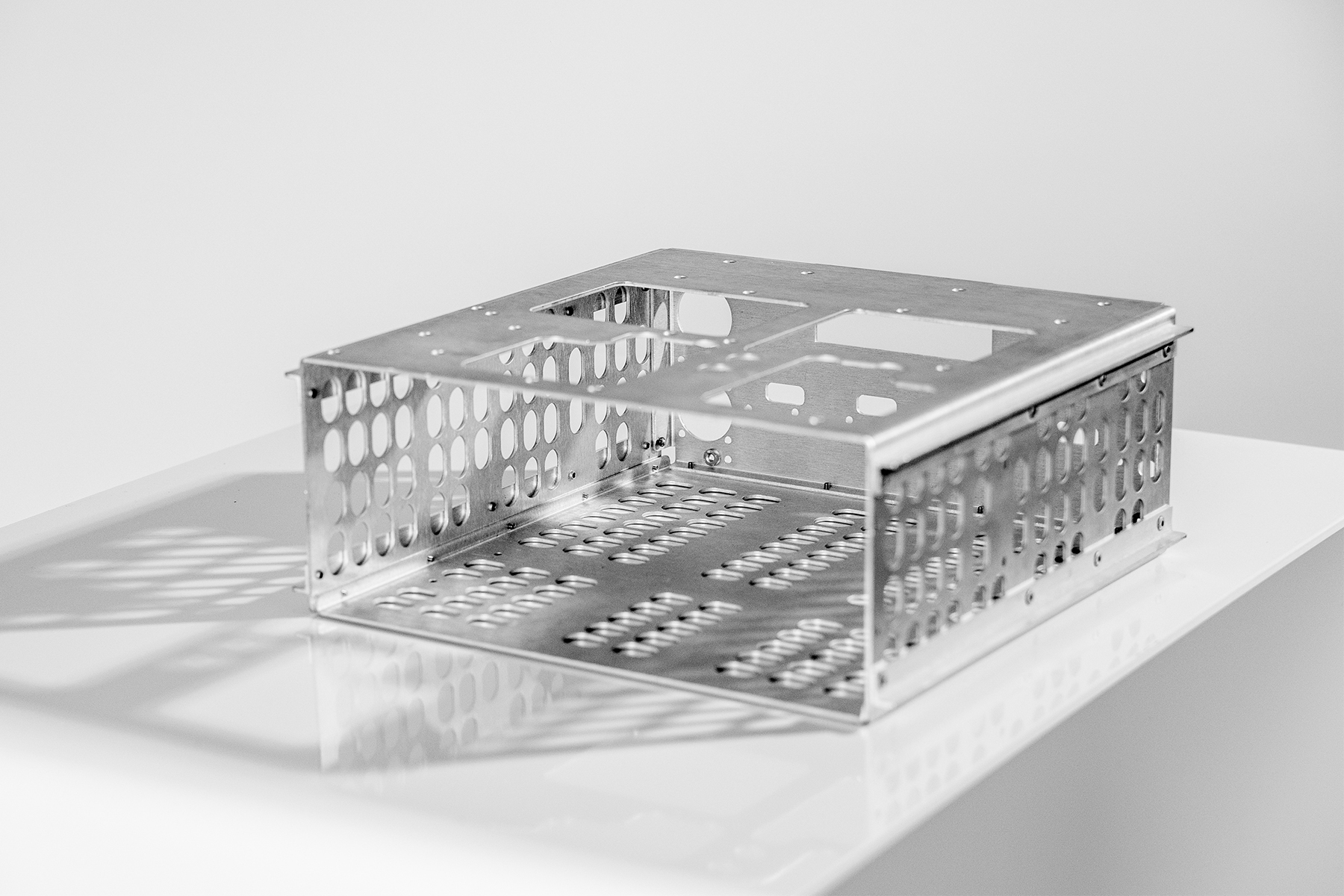
Aluminum is highly valued for its lightweight properties. However, designers and manufacturers know this material demands tightly controlled processes. The goal isn't just to process it, but to maintain dimensional precision, structural stability, and production continuity throughout.
Aluminum's appealing properties, such as high thermal conductivity and ductility, can complicate its fabrication. Incorrect parameter management risks deformations, out-of-tolerance parts, scrap, and rework – directly impacting costs and delivery times.
Cutting and bending are two critical stages in aluminum fabrication. In laser cutting, for example, heat management is crucial. The material's high thermal conductivity leads to rapid energy dispersion, and incorrect parameterization can cause workpiece deformation.
Even minor geometric alterations can compromise subsequent operations. A deformed component, for instance, may not position correctly in welding fixtures, complicating adherence to design specifications.
Bending also presents specific challenges. Aluminum alloys exhibit more pronounced springback compared to other materials, requiring precise anticipation during the development phase. Incorrect assessment easily leads to out-of-tolerance parts.
This necessitates not only adequate tooling but also deep material knowledge and experience applied across various batches and geometries. It is precisely in this context that MIBA effectively reduces scrap and ensures part conformity from the earliest production stages.
Welding is one of the most delicate phases in aluminum and aluminum alloy processing. One of the primary aspects to manage is the presence of the surface oxide layer, which demands meticulous preparation before welding.
During TIG or MIG processes, aluminum requires carefully controlled heat input. If heat is not managed correctly, it can propagate through the structure, causing deformations that compromise component fit-up.
In more complex assemblies, this risks misalignment, non-uniform shrinkage, and fastening points that deviate from the design. Preventing these issues requires a multi-faceted approach: fixture design, welding sequence, part clamping, and continuous control of process parameters.
MIBA addresses these criticalities with an integrated approach that maintains dimensional stability even on complex, large-scale assemblies. Surface finishes also play a crucial role. Beyond aesthetics, these treatments enhance corrosion and wear resistance, tailored to the component's final application. Our control over the entire production cycle, from raw material to final treatments, is supported by acquired certifications. This ensures traceability, process control, and conformity of the finished component to required specifications.
MIBA turns your ideas into reality.
We carry out customised work according to your specifications and support you every step of the way.