


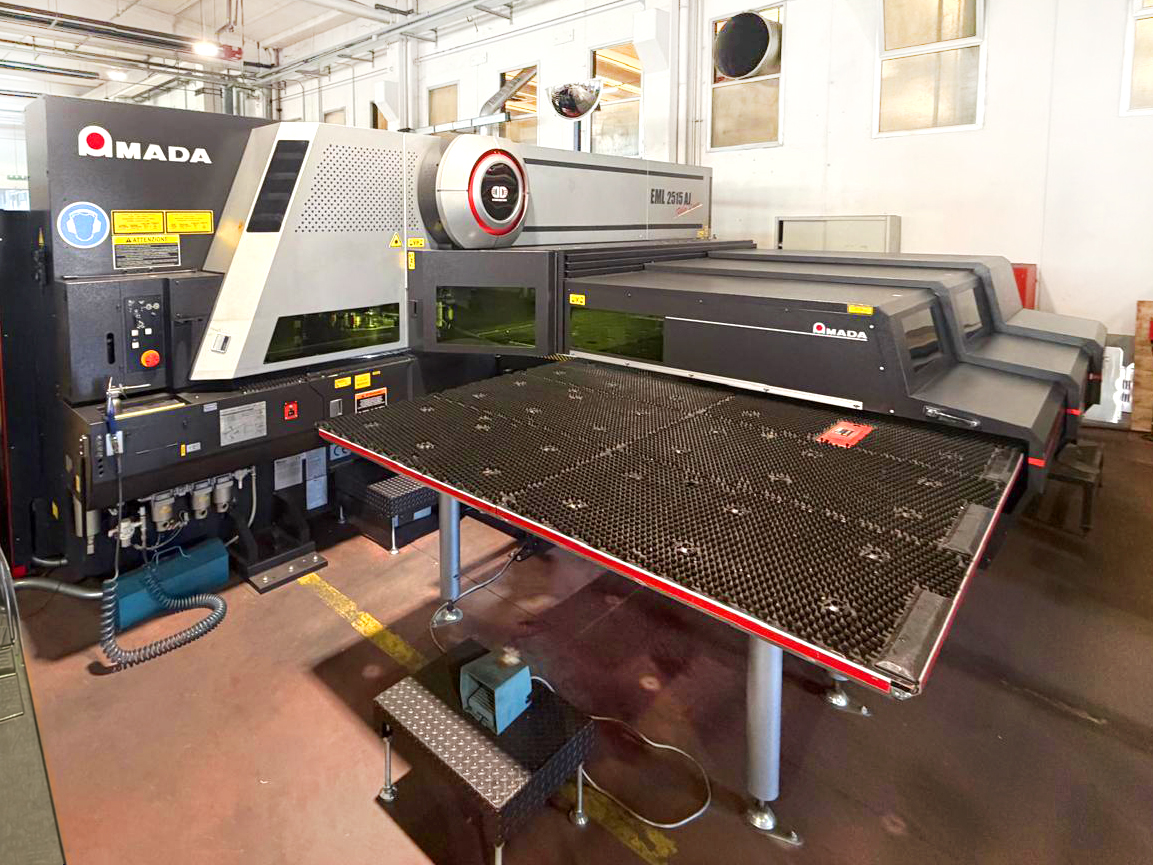
In the landscape of modern sheet metal fabrication, where precision, flexibility, and cost optimization are decisive competitive factors, the combined punch-fiber laser system stands as one of the most advanced solutions available today. This technology integrates the benefits of CNC punching and fiber laser cutting into a single system, allowing for the production of complex components with high accuracy, repeatability, and a more efficient production cycle.
MIBA distinguishes itself in the metal fabrication sector by supporting designers, purchasing managers, and technical personnel with cutting-edge solutions, specifically designed to meet the market's most demanding requirements. This combined system represents a tangible evolution in sheet metal fabrication, as it merges two complementary technologies: the speed and efficiency of punching for repetitive operations on one hand, and the geometric freedom and cut quality of fiber laser on the other.
Punching rapidly creates holes, slots, threads, deformations, and forming operations using dedicated tools and precise, repeatable CNC control. The fiber laser, conversely, handles complex contours, intricate shapes, and details that would otherwise require multiple passes or specific tools with punching alone. The result is an extremely versatile fabrication process, adaptable to both mass production and the creation of parts with variable or more sophisticated geometries.
For production managers, this translates into reduced setup times, a simplified operational workflow, and an increased ability to quickly respond to diverse orders. A single system can manage operations that, in other contexts, would require multiple machines or distinct phases.
One of this technology's most compelling aspects is its ability to combine productivity and flexibility. While punching offers significant advantages for repetitive operations and deformations, the fiber laser overcomes limitations related to part geometry, providing much broader design freedom.
This approach is particularly beneficial for components that simultaneously require:
Another tangible benefit is the reduction of internal material handling. Moving a part from one machine to another increases time, logistical costs, potential for error, and risks of misalignment. With the combined system, many operations are performed continuously within the same cycle, directly benefiting final quality and process efficiency.
From a technical standpoint, the fiber laser's presence makes the system highly effective even for intricate contours and frequent design changes. While punching alone requires the availability of the right tool, the laser allows for greater flexibility, simplifying the management of variants, prototypes, and customizations without compromising productivity.
Material deformation is also addressed in a more advanced manner. Punching operates cold, significantly limiting issues related to thermal input. The fiber laser, in turn, ensures high cut quality and excellent precision, especially when integrated into a well-controlled and optimized process. This integration of both technologies allows for choosing the most suitable method each time, based on geometry, thickness, tolerances, and quantity.
The combined punch-fiber laser system finds ideal application in all sectors where sheet metal requires processing with precision, continuity, and cost rationalization. Consider, for instance, the production of electrical enclosures, industrial machinery frames, lighting components, technical paneling, chassis, brackets, and metal structures involving multiple operations.
In these scenarios, the ability to perform punching, shaping, marking, deformations, and complex cuts on the same part offers a significant competitive advantage. A component requiring numerous operations no longer needs to move through multiple departments or machines; the combined system streamlines the process and ensures higher dimensional consistency.
Consider, for example, the production of frames for a new industrial product. Some details can be rapidly produced using punching, while others, more complex or non-standardized, are executed with the fiber laser. This optimizes machine time and achieves the best balance between speed, precision, and unit cost.
The same applies to the creation of jigs, technical supports, and components destined for assembly. When tolerances must be consistently met, an integrated process reduces the risk of rework, downstream errors, and delays in subsequent phases.
Partnering with MIBA means choosing a partner capable of maximizing the potential of the combined punch-fiber laser system. The real advantage lies not just in machine availability, but in our strategic application of the technology, consistently selecting the most efficient method for each operation.
It's not merely about cutting or punching sheet metal; it's about understanding material behavior, determining the optimal processing sequence, maximizing nesting efficiency, and knowing when to leverage the speed of punching versus the higher performance of fiber laser. This approach delivers a final product that is more efficient, precise, and competitive.
Integrating various operations into a single cycle – such as punching, laser cutting, deformation, threading, and marking – reduces production times, handling costs, and the potential for error. For a purchasing manager, this means greater cost control; for a designer, broader development freedom; and for a technical CEO, a leaner, more reliable, and less fragmented supply chain.
This is precisely the value MIBA brings to the process: not just advanced technology, but the ability to transform it into a tangible advantage for the client, thanks to consolidated expertise and a vision focused on quality, efficiency, and production continuity.
The combined punch-fiber laser system stands today as one of the most effective solutions for industrial sheet metal fabrication demands. It unites the productivity of punching with the precision and geometric freedom of laser cutting, enabling smarter production management, especially when speed, repeatability, and versatility are critical.
MIBA turns your ideas into reality.
We carry out customised work according to your specifications and support you every step of the way.