



A fragmented mechanical supply chain can generate hidden costs, delays, and significant inefficiencies. Tolerance issues, misalignments, and non-conformities often stem from the accumulation of small discrepancies across operations entrusted to different, uncoordinated suppliers.
Choosing an integrated industrial partner like MIBA transforms these critical issues into a competitive advantage, improving process control, supply predictability, and reducing the Total Cost of Ownership.
A company commissions the production of a series of welded frames. During assembly, however, problems arise: tolerances do not match, welding fixtures are inadequate, and boreholes are misaligned.
The cause is not necessarily attributable to a single error, but can stem from a series of small discrepancies accumulated along a fragmented subcontracting chain.
This scenario represents a major criticality in managing an unoptimized mechanical supply chain a problem capable of generating hidden costs, slowdowns, and operational inefficiencies.
An industrial partner with an integrated vision of the entire production process can transform this vulnerability into a competitive advantage, ensuring greater control, continuity, and predictability.
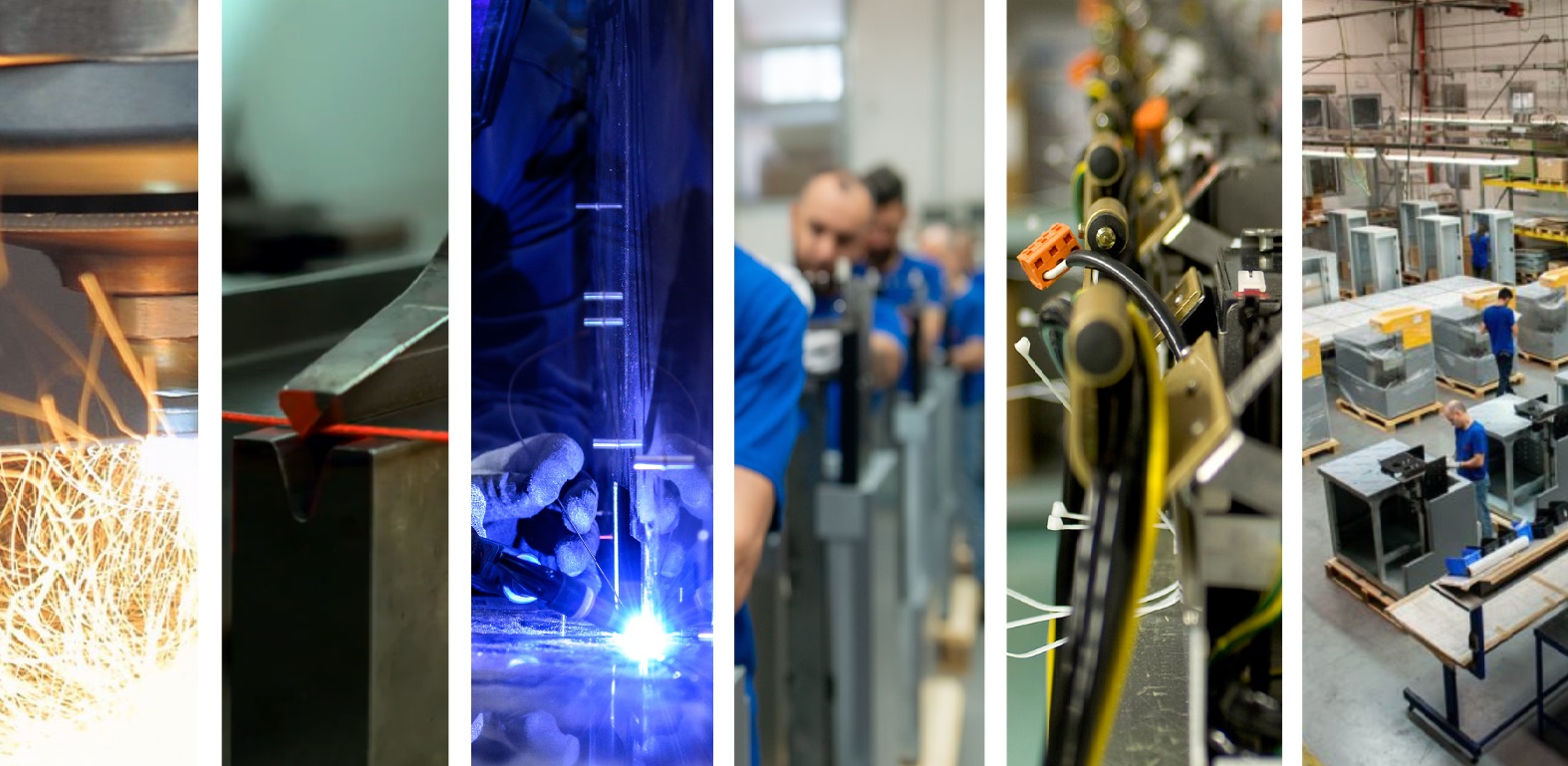
The complexity of mechanical subcontracting lies in the sequential and interdependent nature of its operations. Every phase, from laser cutting to bending, from welding to surface treatments, directly influences the next.
A concrete example involves thermal deformations of materials. A component might be cut and bent correctly, but if the subsequent welding phase fails to account for heat-induced stresses, the final part can deform and become unusable.
When these operations are entrusted to different suppliers without central technical oversight, the risk of non-conformities increases.
This is not necessarily the welder's or the bender's error, but a criticality of the entire process. A single point of contact could have foreseen and prevented it by adjusting the sequence of operations or designing appropriate containment fixtures.
The same principle applies to managing dimensional tolerances. The accumulation of small deviations, individually acceptable, can lead to a final component being out of specification, making assembly difficult or impossible.
These technical issues translate into economic and strategic consequences that extend far beyond the value of the individual non-conforming component.
Scrap represents a direct loss of material, energy, and labor hours. The time required to correct, rework, or reproduce defective components can jeopardize agreed-upon deadlines with the end customer, risking penalties and reputational damage.
Adding to these costs is the time spent by technical staff, designers, and the purchasing department to pinpoint responsibilities, coordinate suppliers, and resolve critical issues.
These are resources diverted from higher-value activities such as innovation, design, and new product development.
Entrusting your projects to a single partner like MIBA, which boasts 50 years of experience in metal fabrication processes, means addressing these issues upstream, reducing the structural causes of inefficiencies.
Transitioning from fragmented subcontracting to an integrated partnership model means shifting focus from managing individual operations to controlling the entire production process.
A partner who assumes responsibility for the entire production cycle, from raw material management to the assembled and tested component, offers a level of coordination difficult to achieve through a supply chain comprising multiple independent suppliers.
This approach is built on rigorous control of technical documentation and work cycles. Every operator can thus work based on the same updated information, following defined and shared procedures.
The traceability of operations becomes comprehensive, and quality management transforms into an operational tool to ensure consistency, safety, and repeatability.
The cost of a single operation is not the only parameter to consider when choosing a supplier.
Eliminating or reducing costs related to non-conformities, reworks, delays, scrap, and the administrative management of multiple contacts can generate significant overall savings.
Evaluating the Total Cost of Ownership therefore means considering the entire cost of the supply, not just the price of the individual component.
A single point of contact simplifies communication and accelerates decision-making processes.
A design modification can be evaluated and applied across the entire production chain without having to separately coordinate various suppliers, renegotiating timelines, methods, and conditions each time.
In a market demanding speed and adaptability, this responsiveness represents a crucial competitive factor.
Integrated management allows for anticipating criticalities, coordinating various operations, and verifying compatibility between different production phases.
The result is greater supply stability, accompanied by a reduction in technical, economic, and organizational risks.
MIBA applies this model by offering its clients not only production capacity but also a wealth of expertise developed over 50 years in metal fabrication and complex process management.
The objective is to transform the supply chain from a mere cost center into a strategic lever, capable of improving efficiency, reducing risks, and supporting the competitiveness of the entire industrial project.MIBA turns your ideas into reality.
We carry out customised work according to your specifications and support you every step of the way.