Sheet metal bending: the art of giving form and function to metal
December 24, 2025
Summary
In the process of transforming sheet metal, cutting defines the perimeter, but it is bending that creates the space, structure, and function. Transforming a flat sheet into a complex three-dimensional component requires a perfect mix of advanced technology and craftsmanship sensibilities. The sheet metal bending is a critical phase where tolerances determine the success of the final assembly. MIBA presides over this technology with a state-of-the-art fleet of machines and established know-how, offering its customers not just execution, but true product optimization consulting.____________________________________________________________________________________________________________________________
If we look at an industrial machine, an electrical panel or a medical device, what we see is a set of volumes, angles and textured surfaces. All this arises from flat sheets of metal. The crucial step that gives structural rigidity and defines the aesthetics of these objects is the sheet metal bending.Often underestimated compared to the laser cutting, this stage is actually the true test of manufacturing precision. An erroneous half-degree bend, or a position one millimeter off axis, can make it impossible to assemble an entire frame or compromise the tight closure of a door.At MIBA, we see bending as the moment when design comes to life. This is where designers' ideas become solid objects, capable of supporting weights, protecting components, and interacting with the user.
Technology and control: the heart of the MIBA department
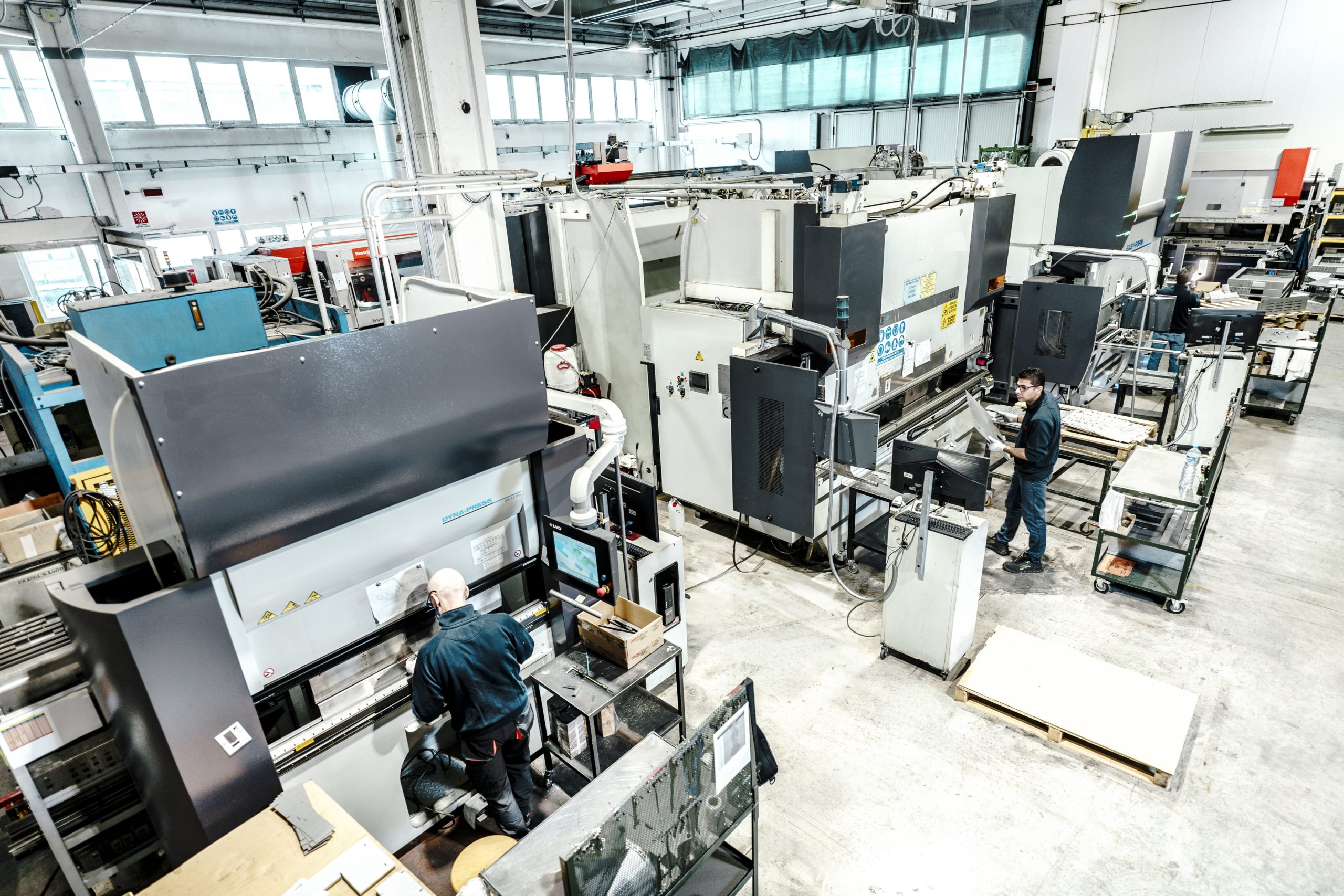
Tackling complex projects requires appropriate tools. Our department dedicated to sheet metal bending is equipped with a fleet of state-of-the-art CNC press brakes. These machines allow us to handle a very wide range of machining operations:
Constant angular accuracy:thanks to real-time angle control systems, we compensate for material spring-back, which varies according to the type of steel or aluminum and the direction of the rolling fibers.
Management of variable formats and thicknesses: from thin sheets for electronics (a few tenths of a millimeter) to heavy structural thicknesses for machine frames, our equipment provides the power and gentleness needed for every application.
Rapid tooling:flexibility is key. We use rapid tool change systems and off-line programming software that allow us to go from producing one prototype to a series of thousands of parts while minimizing downtime.
In the Sheet metal bending, However, the machine does not do everything by itself. The skill of the operator, able to interpret the behavior of the metal and sequence the bends in the correct way to avoid collisions, remains an irreplaceable factor in quality.
Beyond execution: the value of co-engineering
Many defects or cost overruns arise before the metal even reaches the shop floor, right on the drawing board. A bend radius too tight for the thickness chosen, a flange too short to be taken by the machine, or a sequence of bends physically impossible to make without special tools.This is where MIBA offers its strategic added value.Our expertise in the sheet metal bending results in a co-engineering and DFX (Design for Excellence) service. We analyze customers' 3D models before production and suggest changes that simplify the process without compromising functionality.Sometimes all it takes is to add a corner drain, slightly modify a radius, or join two components into one via multiple bends to dramatically reduce manufacturing costs and improve the strength of the final part.
Folding and integration: thinking about the next step
For MIBA, the sheet metal bending is never an end in itself, but part of an integrated flow.We know that bent piece will have to be welded, painted, and assembled.Therefore, we pay close attention to details that facilitate the next steps:
Preparation for welding:We make folds with precise fits that reduce the need for masks of Welding complex and minimize the heat input required.
Respect for surfaces:we use protective films and special scratch-resistant dies when processing fine materials such as satin-finished stainless steel or prepainted aluminum, ensuring that the part comes out of the bender aesthetically perfect.
Repeatability for assembly: the dimensional consistency we guarantee in the sheet metal bending is the basic premise for our "Free Pass" philosophy. Bent parts will always fit correctly, eliminating manual adjustments during final assembly.
Certified quality in every corner
Whether it is an interior bracket that is not visible or the exterior body of a machinery medical, the quality standard remains unchanged.Our processes of sheet metal bending are integrated into the management system of the quality ISO 9001. We perform dimensional inspections on the machine and spot checks with advanced measuring instruments, ensuring full traceability of each batch.This rigorousness allows us to serve demanding industries such as automotive, electro-medical and industrial automation, where precision is not an option but a safety requirement.
The shape of competence
Shaping metal is an ancient craft that now requires future technologies.Choose MIBA for the processing of sheet metal bending means relying on a partner that combines industrial power and design intelligence.We don't just bend metal to a design; we work to give your product the best possible shape, optimizing cost, aesthetics, and structural functionality in one integrated process.